
Staying strong in later life: a practical guide to preventing frailty
Most people assume that growing weaker with age is simply something that happens. But the science tells a different story. **Muscle decline is real but it is largely preventable, and in many cases reversible.** The earlier we act, the more we can protect.
Every decade from age 50 onwards, adults lose roughly 1–2% of their muscle mass each year, a condition known as sarcopenia. After 70, this process can accelerate. But the same research that documents this decline also shows clearly that targeted exercise and the right nutrition can slow, halt, and even reverse it.
Key statistics
**1 in 10** older UK adults has sarcopenia in the general population
**1–2%** muscle mass lost per year after age 50
**12 weeks** minimum resistance training needed for meaningful improvement
What is sarcopenia and how does it become frailty?
Sarcopenia is the gradual loss of muscle mass, strength, and function that accompanies ageing. It begins subtly often in our fifties and accelerates if left unaddressed. The word comes from the Greek for “loss of flesh” and has only recently been formally recognised as a disease in its own right.
Frailty is the broader condition that sarcopenia often leads to: a state in which the body has diminished reserves and reduced capacity to recover from everyday stressors illness, injury, or even a simple infection. Frailty is not just about being physically weak; it affects energy, resilience, and independence.
Crucially, frailty exists on a spectrum. The early stage sometimes called “pre-frailty” is where intervention is most effective. This is when the cycle can genuinely be broken.
**The good news:** frailty is reversible, especially when caught early. Research consistently shows that resistance training twice a week, combined with adequate protein, can improve muscle strength, physical function, and frailty status even in adults in their 80s and 90s.
The early warning signs
The signs of muscle decline are often subtle at first and easy to explain away as “just getting older.” But each one is meaningful, and noticing them early creates the best opportunity to act.
**Difficulty rising from a chair** : Needing to push up with hands, or struggling to get up without support, is one of the clearest signs of declining leg strength.
**Weakening grip** : A noticeably softer handshake, difficulty opening jars, or struggling with lids grip strength is a reliable marker of overall muscle health.
**Unexplained weight loss** : Losing weight without trying particularly lean body mass is a key frailty indicator, especially combined with reduced appetite.
**Persistent fatigue** : Feeling more tired than usual despite adequate rest, or exhaustion from activities that previously felt easy.
**Slowing down** : A noticeably slower walking pace, or taking longer to do everyday tasks, often reflects declining muscle power and endurance.
**Reduced activity** : Withdrawing from walks, outings, or physical activities often due to fear of falling or simply lacking the energy accelerates the decline it’s trying to avoid.
The Abney & Baker approach
At Abney & Baker, maintaining muscle strength and preventing frailty is at the heart of our care model. It sits within the first of our **Five Pillars of Living Well at Home** but as the framework shows, strength connects to everything else.
**Five Pillars of Living Well at Home:**
**Strength, balance & mobility** – Preventing frailty through guided movement, resistance exercise, and physical confidence. _(This guide)_
**Mind & memory** – Keeping mentally active and engaged to protect memory, mental agility, and emotional wellbeing.
**Nutrition & hydration** – Supporting healthy eating and adequate protein to boost energy, muscle health, and overall wellbeing.
**Social connection** – Helping people stay connected, confident, and actively involved in their community.
**Home safety** – Identifying and reducing hazards so that home remains a safe and comfortable place to live.
Every Abney & Baker care plan begins with an in-depth assessment across all five pillars exploring not just physical capability, but nutrition, social connection, and home environment. Because strength doesn’t exist in isolation.
Exercise: the most powerful tool
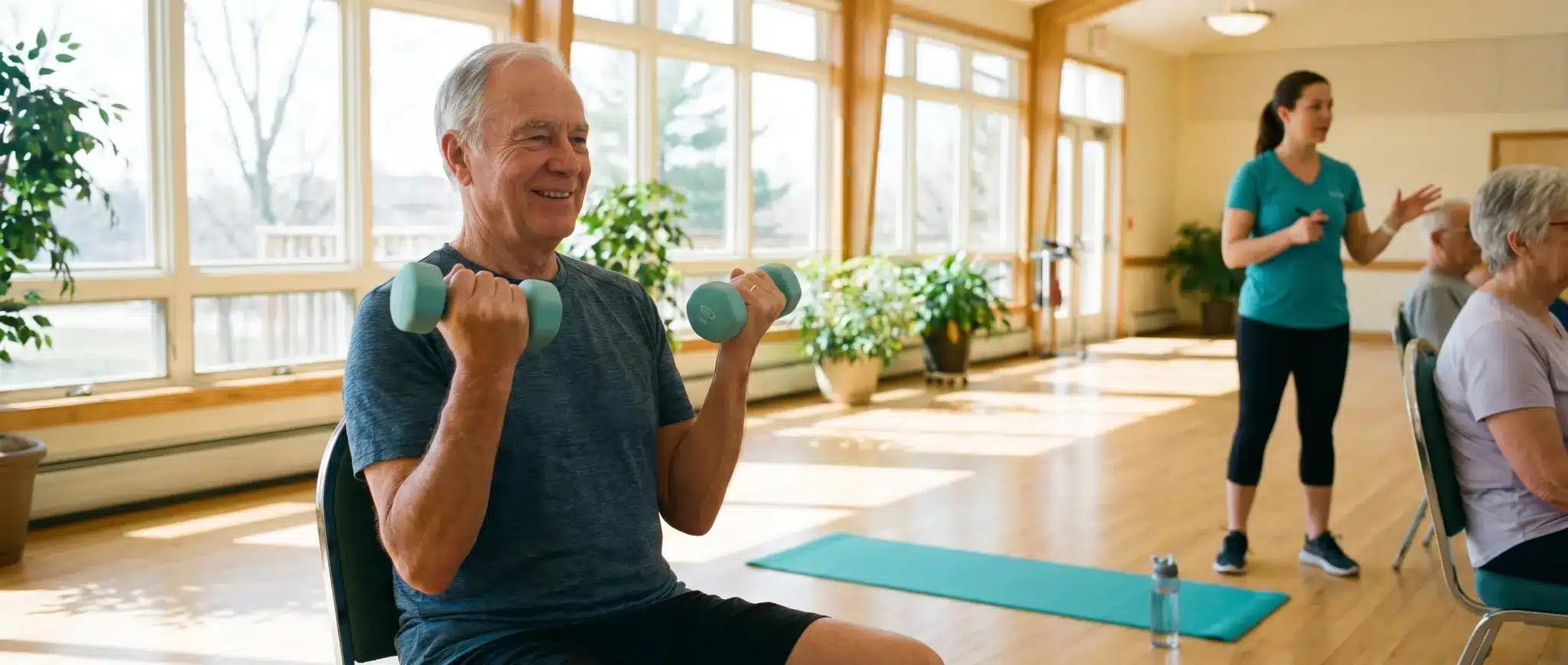
Resistance training exercise that works muscles against load or resistance is the most evidence-based intervention for both preventing and reversing sarcopenia and frailty. Research involving thousands of participants shows it can improve muscle strength, physical function, and even frailty status in older adults, including those in their eighties and nineties.
The key parameters: at least twice a week, for a minimum of 12 weeks, with gradual progression in difficulty. Shorter programmes rarely allow sufficient time to build habit or meaningful physiological change.
**Exercises to do at home:**
**Sit-to-stand.** Rise from a chair without using your hands. This builds precisely the leg muscles needed to stay independently mobile. Start with 5 repetitions, build toward 10–15 twice daily.
**Wall push-ups.** Stand facing a wall, place your hands at shoulder height, and slowly lower and push back. Builds upper body and core strength safely, without floor work.
**Calf raises.** Stand at the kitchen counter, rise slowly onto tiptoes, then lower. Strengthens the lower leg essential for balance and walking stability.
**Step-ups.** Using the bottom stair and holding the rail, step up and down with each foot. Builds leg power and challenges balance safely.
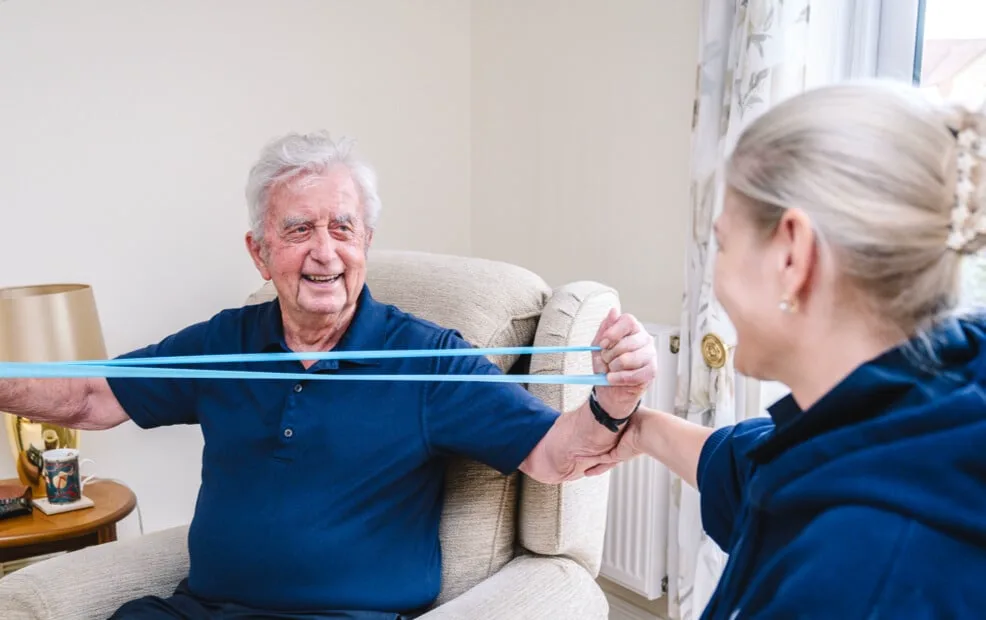
**Resistance band exercises.** Light resistance bands add load to exercises without heavy weights. Bicep curls, shoulder presses, and seated rows can all be done from a chair.
All exercises should be approached carefully. If you have not been active recently, have a health condition, or have had a recent fall, speak to your GP before starting. A trained coach such as through Abney & Baker’s PREVENT+ programme can ensure exercises are safe, appropriate, and correctly progressed from the outset.
Resistance training can be effective at any age — even from a chair at home
PREVENT+: expert-led strength & balance coaching at home
For those who want structured, expert-led support rather than exercising alone, Abney & Baker offers PREVENT+ a proactive physical health programme powered by EverFit, led by expert coach Georgie Britt.
PREVENT+ is designed for people at any stage of the strength and frailty spectrum whether they want to get ahead of decline, recover from a recent health setback, or simply feel stronger and more confident. Every programme is tailored to the individual.
**What PREVENT+ includes:**
**Progressive resistance training** – Evidence-based programme that builds strength safely and systematically over time
**Balance and mobility work** – Reduces fall risk while improving confidence in everyday movement
**Expert coaching** – Led by Georgie Britt, trained EverFit coach with specialist expertise in later life movement
**Delivered at home** – No gym required exercises are tailored to what’s safely achievable in your own space
> “He’s getting stronger, his balance has improved, and he now walks outside without his sticks. He’s even started working in the garden again and recently, he told me he’s thinking about starting bowls again.” > > _– Georgie Britt, EverFit coach, on a client’s progress through PREVENT+_
PREVENT+ works as a standalone programme, or alongside our FLEXICARE and PREVENT home care services. It’s especially valuable after a period of illness, a hospital stay, or when someone notices they are beginning to slow down.
**Find out more about PREVENT+** \| **Talk to the team**
Nutrition: the essential partner to exercise
Exercise alone is not enough without adequate nutrition, the body cannot build or maintain the muscle that exercise is trying to preserve. The combination of resistance training and sufficient protein is consistently shown to produce the best outcomes for muscle health in older adults.
Protein
Older adults need significantly more protein than is commonly assumed. European clinical guidelines recommend at least **1.0 to 1.2 grams of protein per kilogram of body weight per day** for healthy older adults – nearly 50% more than the standard adult recommendation. For someone weighing 70kg, that is 70–84g of protein per day.
Protein should ideally be spread across the day, with a good source at every meal – not concentrated in one sitting. Good sources include eggs, fish, chicken, dairy products, beans, lentils, chickpeas, and tofu. Protein supplements can be useful where whole food intake is difficult, but whole food sources are generally preferred.
Vitamin D
Vitamin D plays a direct role in muscle function, not just bone health. Deficiency is extremely common in older UK adults, particularly from October to March which leads to muscle weakness and reduced physical performance. The NHS recommends a daily supplement of 10 micrograms (400 IU) for all adults, year-round for those who are housebound or have limited sun exposure.
Maintaining a healthy weight
Both underweight and overweight in later life are associated with frailty. Unintentional weight loss particularly the loss of lean muscle mass is a key warning sign. If weight is dropping without a change in diet or activity, this warrants a conversation with a GP.
Strength self-assessment checklist
This checklist is not a clinical diagnosis but it can help you identify whether it’s time to act, and what to prioritise.
**Check this and tick which that applies to you:**
**Physical health**
I can rise from a chair without pushing up with my hands
My grip feels as strong as it did a year ago
I can climb a flight of stairs without stopping to rest
I can carry shopping bags without difficulty
My walking pace feels about the same as 12 months ago
**Energy & weight:**
My energy levels are consistent – I don’t tire more easily than before
My weight has been stable over the past 6 months (within 2–3kg)
My appetite is good – I eat regular meals with protein at most of them
**Activity & confidence:**
I do some form of physical activity (walking, gardening, exercise) at least 3 times a week
I feel confident moving around at home and outside
I haven’t reduced or avoided activities because of weakness or fear of falling
I take a vitamin D supplement (or get adequate sun exposure)
**How to use this checklist:** if you ticked fewer than 8 items, or left several in one category unticked, it’s worth taking action now. The more items that weren’t ticked, the more urgently it’s worth speaking to a GP or getting in touch with us.
When to seek further help
If you or a family member has noticed any of the warning signs in this guide or if the self-assessment raised concerns these are the next steps to consider:
Speak to your GP ask specifically about a frailty assessment and whether a physiotherapy referral would be appropriate
Request a medication review if you take four or more medications some contribute to fatigue, muscle weakness, and reduced appetite
Contact Abney & Baker directly to ask about PREVENT+ no GP referral needed, and we can usually begin quickly
If unintentional weight loss is significant or rapid, seek medical advice promptly it can have several causes, some of which benefit from early treatment
The most important thing is not to wait. Frailty that is caught early is far easier to reverse than frailty that has become entrenched over months or years.
Frequently asked questions
**What is sarcopenia and how common is it in the UK?**
Sarcopenia is the progressive loss of muscle mass, strength, and function that occurs with ageing. It affects around 1 in 10 older adults in the general UK population, rising to up to half of those aged 80 and over. Muscle loss begins gradually from around age 30, accelerates after 50 at roughly 1–2% per year, and can reach 15% per decade after 70. It was formally recognised as a disease with its own diagnostic code in 2019.
**What are the early warning signs of frailty?**
The early signs of frailty include: difficulty rising from a chair without pushing up with your hands; a noticeably weakening grip; unintentional weight loss (particularly of lean muscle); feeling more tired than usual despite adequate sleep; and slowing down with walking or everyday tasks. Frailty is most reversible when addressed at this early ‘pre-frail’ stage.
**Is frailty reversible?**
Yes. Frailty particularly in its early stages is reversible. Research consistently shows that resistance training at least twice a week, combined with adequate protein intake, can improve muscle strength, physical function, and frailty status. The key is early intervention.
**How much protein do older adults need to maintain muscle?**
Current European expert guidelines recommend that healthy older adults consume at least 1.0 to 1.2 grams of protein per kilogram of body weight per day significantly more than the standard adult recommendation of 0.8g/kg. For a 70kg person, that is 70–84g of protein per day. Protein should be spread across the day, with a good source at every meal.
**What exercises are best for preventing frailty?**
Resistance training is the most effective exercise type for preventing and reversing frailty. Effective exercises for older adults include: sit-to-stand from a chair without using hands, wall push-ups, calf raises, and step-ups onto a low step. These can be done at home safely. Programmes should last at least 12 weeks and progress gradually in difficulty.
**What is PREVENT+ and how does it help with frailty?**
PREVENT+ is a specialist proactive strength and balance programme offered by Abney & Baker, powered by EverFit and led by expert coach Georgie Britt. It is specifically designed to help older adults improve muscle strength, balance, and mobility through safe, tailored movement reducing the risk of falls and rebuilding confidence. To find out more, call 0333 043 4880.
**What role does vitamin D play in muscle strength?**
Vitamin D plays a direct role in muscle function. Deficiency which is extremely common in older UK adults, particularly in autumn and winter leads to muscle weakness, increased fall risk, and reduced physical performance. The NHS recommends a daily supplement of 10 micrograms (400 IU) for all adults throughout the year.
**When should I speak to a GP about frailty?**
Speak to a GP if you or a family member notices: difficulty rising from a chair without arm support; unexplained weight loss over the past year; persistent fatigue despite adequate rest; a noticeably slower walking pace; or recurrent falls or near-misses. A GP can carry out a frailty assessment and refer to appropriate services.
Download the full guide
Download the complete Abney & Baker Guide to Muscle Strength & Frailty as a PDF — ideal for reading offline or sharing with a family member or carer.
Download your muscle strength & frailty guide
Ready to take the next step?
If you’d like to find out more about how Abney & Baker can help you or a family member stay strong, independent, and well at home, we’d love to hear from you.
We’re always here if you want to chat about your care options
Speak to a real person about how care at home can help you or your loved one.