_Falls are the most common cause of injury in later life but most are preventable. This guide explains what puts older people at risk, the steps that make the biggest difference, and how a structured programme can help rebuild confidence and strength by reducing falls and their severe consequences, such as hip fractures, head injuries, loss of independence, and increased mortality. Osteoporosis affects over 3 million people in the UK, increasing their risk of fragility fractures from low-level trauma such as a fall from standing height._
Around **one in three people over 65** has a fall at least once a year. Falls are common among older adults, with over 30% of individuals aged 65 and older experiencing a fall each year, and this percentage increases to around 40% for those aged 85 and above. For many, a fall marks a turning point and not just because of the physical injury, but because of the loss of confidence that follows. People who have fallen often become more cautious about moving around, which in turn weakens the muscles and balance they need to stay safe. Decreased activity levels after a fall can further increase the risk of falling again and negatively impact overall health.
Falls are a leading cause of accidental death among adults over 65.
The good news is that this cycle is not inevitable. Falls are rarely random – they result from a combination of risk factors, most of which can be reduced or removed. The earlier those risks are addressed, the better.
1 in 3
Adults over 65 fall at least once a year
30-50%
of falls involve home hazards
24%
fall risk reduction from regular exercise
Why falls happen
A fall is defined as an event where a person unintentionally comes to rest on the ground or a lower level, not caused by a major event (such as a stroke) or overwhelming hazard. Falls in older people are almost always the result of several factors combining at once such as a moment of dizziness, a loose rug, a medication that affects balance. Both intrinsic factors (such as personal health and medical conditions) and extrinsic factors (such as environmental hazards) are categorized as causes of falls. Understanding these fall risks and the circumstances that contribute to them is the starting point for prevention.
**Muscle weakness**
Especially in the legs and core the muscles that keep us upright and help us recover when we stumble. Muscle weakness is a key intrinsic factor.
**Balance problems**
Often linked to inner ear changes, medication side effects, or simply not doing enough balance-challenging activity. Impaired balance, reduced muscle strength, and gait difficulties are intrinsic factors that increase risk.
**Certain medications**
Sedatives, antidepressants, blood pressure medications, and diuretics are among the most common culprits. Polypharmacy (taking multiple medications) and specific medical conditions such as diabetes, depression, and arthritis are associated with increased risk of falls in older adults.
**Home hazards**
Muscle weakness is a key intrinsic factor.Loose rugs, poor lighting, trailing cables, and bathrooms without support rails account for a significant proportion of falls. Environmental factors such as poor lighting, uneven surfaces, and slippery floors are extrinsic factors and account for 30%-50% of falls among older adults.
**Dehydration**
Not drinking enough causes blood pressure to drop when standing, leading to dizziness or making you feel lightheaded – a major and often overlooked trigger.
**Poor vision**
Glaucoma, cataracts, or an out-of-date glasses prescription can affect depth perception and hazard detection. Sensory impairments are also important intrinsic risk factors.
**The most important insight:**
the two strongest predictors of a fall are a history of previous falls, and problems with gait or balance , not just age alone. If either of these applies, it’s worth acting now. The risk of falling increases with the number of risk factors present; for example, the one-year risk of falling doubles with each additional risk factor, starting at 8% with no risk factors and increasing to 78% with four risk factors.
The Abney & Baker approach
At Abney & Baker, falls prevention isn’t a single service – it runs through everything we do. Our care model is built around the **Five Pillars of Living Well at Home**: a whole-person framework that recognises health and independence which are deeply connected in our work. Falls risk sits in the first pillar, **Physical health** but as you’ll see, everything is connected.
Our initial assessment for upcoming clients is tailored to individual needs, ensuring that each person receives the maximum benefit from our support. By personalizing our approach, we aim to improve outcomes and reduce the risk of falls in the elderly. A range of providers, including healthcare professionals and support staff, collaborate to deliver comprehensive care that addresses all aspects of well-being.
Physical activity and strength
Staying physically active is the single most effective thing an older adult can do to reduce their fall risk. It is important for older adults to stay active every day, as physical activity guidelines recommend daily movement and engaging in activities that improve strength and balance at least twice a week. Surveys and reports measuring activity levels in older adults show that decreased physical activity is linked to increased fall risk and poorer health outcomes.
This doesn’t mean intense exercise it means regular, purposeful movement that challenges balance and builds leg strength. Sarcopenia, or age-related loss of muscle mass, decreases strength and stability, especially in the legs, which increases the risk of falls. Incorporating strength training exercises is a key component to improve strength and reduce fall risk. Regular physical activity, including strength and balance training, helps older adults maintain their strength, balance, and coordination, all of which are crucial for preventing falls.
Balance exercises
Balance programmes have been shown to reduce fall risk by around 24%. Effective balance training doesn’t require a gym, simple exercises done daily at home make a real difference:
**Single leg stand.** Hold the kitchen counter or a sturdy chair. Lift one foot and hold for 10 seconds. Build up to 30 seconds on each side. Balance exercises, such as standing on one foot, help improve stability and reduce the risk of falls.
**Heel-to-toe walking.** Place the heel of one foot directly in front of the toes of the other. Ten steps, twice a day, improves gait stability.
**Sit-to-stand.** Rising from a chair without using hands is particularly effective for building leg strength and improving balance, which are important for fall prevention. Aim for 10 repetitions, twice a day.
**Calf raises.** Stand at the kitchen counter, rise up onto tiptoes, and lower slowly. Strengthens the lower leg and improves ankle stability.
Tai chi is also recognized as a beneficial exercise for older adults, improving postural stability and offering musculoskeletal and cardiopulmonary benefits.
Walking
Regular walking even 20 to 30 minutes a day maintains cardiovascular fitness, leg strength, and balance. Walking on slightly uneven surfaces provides additional balance challenge beyond a perfectly flat pavement.
Abney & Baker specialist service
PREVENT+: rebuilding strength, balance, and confidence
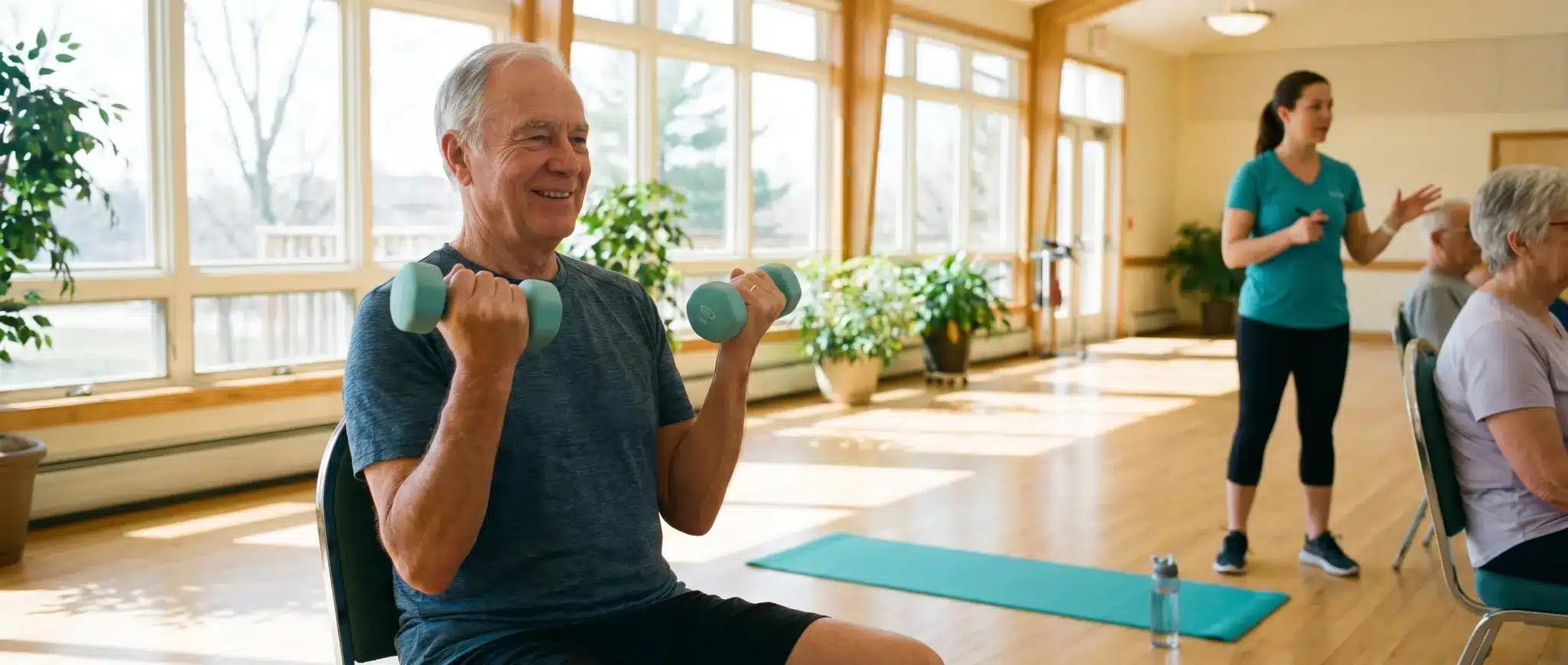
For those who want to actively rebuild their physical capability, Abney & Baker offers **PREVENT+** a proactive physical health programme powered by EverFit, and led by expert coach Georgie Britt.
**PREVENT+** is designed for patients who want to do more than stay safe, they want to manage their fall risk, carry out proactive interventions, and feel capable and confident again. It delivers safe, tailored movement with the warmth and encouragement that defines how Abney & Baker works.
**Improved balance :** Targeted exercises that directly address the physical causes of falls
**Rebuilt strength :** A structured programme that builds leg, core, and overall body strength progressively
**Greater mobility :** Helping people do more of the things they love, safely and confidently
**Expert-led coaching :** Delivered by trained EverFit coaches with specialist knowledge of later life movement
“He’s getting stronger, his balance has improved, and he now walks outside without his sticks. He’s even started working in the garden again and recently, he told me he’s thinking about starting bowls again.”
EverFit Coach, Abney & Baker
on a client's progress through Prevent +
Prevent+
It works as a standalone programme, or alongside FLEXICARE and PREVENT home care services. It is especially valuable after a fall, a hospital stay, or when you notice that your strength or confidence starts to slip.
Talk to our team about how we can help you
Nutrition and hydration
Adequate protein helps preserve the muscle mass that keeps us upright. Calcium and vitamin D are essential nutrients for maintaining strong bones, which help reduce the risk of severe injuries from falls. Good sources include dairy products, fortified soya products, oily fish, and eggs. Vitamin D deficiency is extremely common in older UK adults, especially in winter is directly linked to muscle weakness and increased fall risk. An NHS-recommended daily supplement of 10 micrograms is a simple step, and vitamin D supplementation in doses from 700 IU/d to 1000 IU/d can reduce falls by 19% in community-dwelling older adults after 2-5 months of treatment.
Dehydration causes blood pressure to drop when moving from sitting to standing, and the resulting dizziness or feeling lightheaded is a significant fall trigger. It’s important to stay hydrated aiming for 6 to 8 cups of fluid a day is effective and easy to build into a daily routine.
Medications
Several commonly prescribed medicines increase fall risk by affecting balance, blood pressure, or alertness. Certain medicines, especially when taken together, can cause side effects that increase the risk of falls, particularly in older adults taking multiple medicines (polypharmacy). If you or a family member is on four or more medicines, an annual review with a GP or pharmacist is worth requesting. Pay particular attention to sedatives, blood pressure medicines, diuretics, and some antidepressants.
**Important:** never stop taking prescribed medicines without speaking to your GP first. Ask specifically whether any of your medicines could be affecting your balance or blood pressure.
Vision and footwear
An up-to-date glasses prescription matters, eyes should be checked at least every two years, as regular eye tests are important for older adults; vision problems can affect balance and increase the risk of falls. Backless slippers are one of the most common and most easily changed fall risk factors. The ideal indoor shoe or slipper has a firm back strap, a non-slip sole with a good grip, a low broad heel, and a snug fit. Wearing shoes or slippers that fit well and have a good grip can significantly reduce the risk of falls among older adults.
Home safety checklist
Most falls at home happen in a few key areas. Home safety checks and home modifications such as installing grab bars, improving lighting, and removing tripping hazards are effective in preventing falls in the elderly. Work through this checklist room by room print this page for a paper version you can use around the house.
When to seek further help
This guide covers the most impactful self-directed steps. For some people, a more structured assessment or a specialist programme is the right next move. Consider speaking to a GP, or getting in touch with us, if:
There has already been a fall, or several near-misses
There’s increasing difficulty with walking, balance, or getting up from a chair
There’s unexplained dizziness when standing
A family member has noticed that confidence or mobility seems to have changed
You feel unsteady on your feet, as this can be a warning sign that warrants medical advice
You can request a free care needs assessment from your local council to determine what support or home modifications may be needed. Occupational therapists can visit your home to identify hazards and recommend modifications to reduce fall risks. Local authorities and social care services can also provide ongoing support and rehabilitation after a fall to help maintain independence. In some cases, moving to a care home may be considered as a long-term care option, where fall prevention and management are emphasized in a controlled environment.
For added safety, consider using a personal alarm or carrying a mobile phone so you can call for help if you fall. For further advice and information on falls prevention, visit the NHS website or Age UK, both of which offer trusted resources and guidance.
Falls in the elderly not only have a significant impact on health and independence, but also come with a high cost to health services, including hospitalisation and social care costs, especially for injuries like hip fractures.
A GP can refer to an NHS falls clinic, physiotherapy, or an occupational therapist. Our **PREVENT+** programme is also designed for exactly these situations and can be started quickly, without a GP referral.
Frequently asked questions
**What are the most common causes of falls in older adults?**
Falls in older adults are almost always caused by a combination of factors rather than a single cause. The most common are: **muscle weakness** (especially in the legs and core), **balance problems**, **certain medications** (including sedatives, diuretics, and blood pressure medications), **poor vision**, **dehydration**, and **home hazards** such as loose rugs, poor lighting, and bathrooms without grab rails. Sensory impairments like vision and hearing loss can negatively impact an individual’s ability to spot dangers, increasing the likelihood of falls. Environmental hazards account for 30–50% of all falls.
**What is the most effective way to prevent falls?**
Regular physical activity particularly exercises that challenge balance and build leg strength is the single most effective falls prevention strategy. Balance programmes reduce fall risk by around 24%. Alongside exercise, addressing home hazards, reviewing medications with a GP, staying well hydrated, and wearing appropriate footwear all make a significant difference.
**Can dehydration cause falls in older adults?**
Yes. Dehydration causes blood pressure to drop when moving from sitting to standing, a condition called orthostatic hypotension which produces dizziness and significantly increases fall risk. Older adults are particularly vulnerable because the sensation of thirst diminishes with age. Aiming for 6 to 8 cups of fluid per day is recommended.
**Which medications increase fall risk?**
The main groups are: **sedatives and sleeping tablets** (which cause drowsiness and slow reaction time), **blood pressure medications** (which can cause a sudden pressure drop on standing), **diuretics** (which increase the urgency to reach the bathroom and can cause dehydration), and **some antidepressants** particularly older tricyclic types. Anyone taking four or more medications should request an annual review with their GP or pharmacist.
**What should I do after a fall?**
If you or another patient has fallen, first check for injuries and assess for pain. If pain persists or worsens, seek professional advice from a healthcare provider. If there is any doubt about the severity of injuries, or if the person cannot get up, call for medical help. Even if there are no obvious injuries, it is important to monitor for delayed symptoms and consult a healthcare professional if needed.
**What is the PREVENT+ programme?**
**PREVENT+** is a proactive strength and balance programme offered by **Abney & Baker**, powered by EverFit. It helps older adults improve balance, strength, and mobility through safe, tailored movement by reducing fall risk and rebuilding confidence. It can be taken as a standalone programme or alongside Abney & Baker’s home care services. Call **0333 043 4880** to find out more or visit our services page to find out more.
We’re always here if you want to chat about your care options
Speak to a real person about how care at home can help you or your loved one.